
Redesigning How SeatGeek Sellers Price and Sell Tickets
Impact
- Designed and shipped a pricing growth experiment targeting the 62% of manual sellers pricing outside SeatGeek’s recommended range.
- Redesigned 3 seller-side experiences across Manual Pricing, Smart Pricing, and Pricing Insights, translating complex marketplace data into simpler, more actionable pricing decisions.
- Conducted and moderated research with 5 SeatGeek sellers.
- Defined the end-to-end experiment logic and handoff across pricing states, edge cases, and fallbacks, partnering with Product, Engineering, UX Research, Data Analytics, and Legal to prepare the experience for deployment.
Overview
Turning confusing data into an actionable pricing decision
Selling tickets is hard. Figuring out what to price it at, when to change the price, when to sell, there are so many factors to consider.
Problem
Sellers had information, but weren't making confident pricing decisions
Through an initial audit and conversations with PMs, designers, engineers, and the broader seller team, I identified three core problems:
- Sellers were pricing tickets too high.
- Sellers weren't understanding why they should trust our recommendations.
- Sellers weren't consistently adopting Smart Pricing.



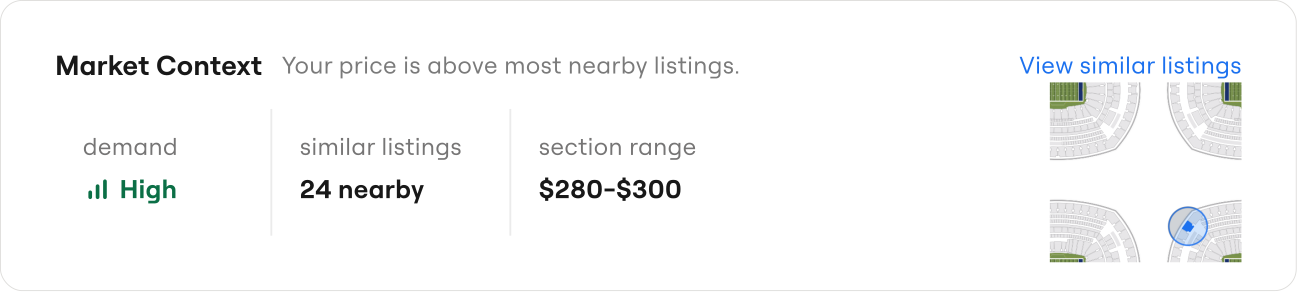
Exploring Pricing Insights
What if we gave sellers more context?
My initial hypothesis was:
Users will price better if we give them more data they can trust.
Redefining Roadmap
Design and product direction changed several times
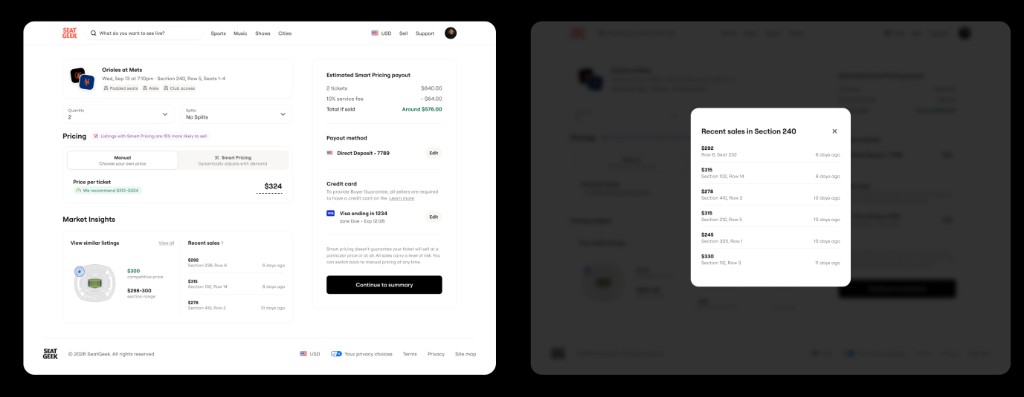
Recent Sales added significant complexity to the experience and increased the amount of information sellers had to interpret.
More importantly, historical analysis showed that recent sale prices were above SeatGeek's recommendation roughly 60–66% of the time.
There were several problems with shipping this growth experiment and after aligning with product and engineering we decided the first issue to tackle would be influencing the pricing decision. A lower lift experiment with higher impact needed to be shipped.
Instead of:
"How can we give sellers more data to help them price better?"
I asked:
"How might we design an experiment that moves the needle and enforces behavior change in sellers?"
Solution
Making the recommendation easier to understand and act on
I explored how pricing insights could help sellers understand:
Where the market is → Where they're priced → Where they should be
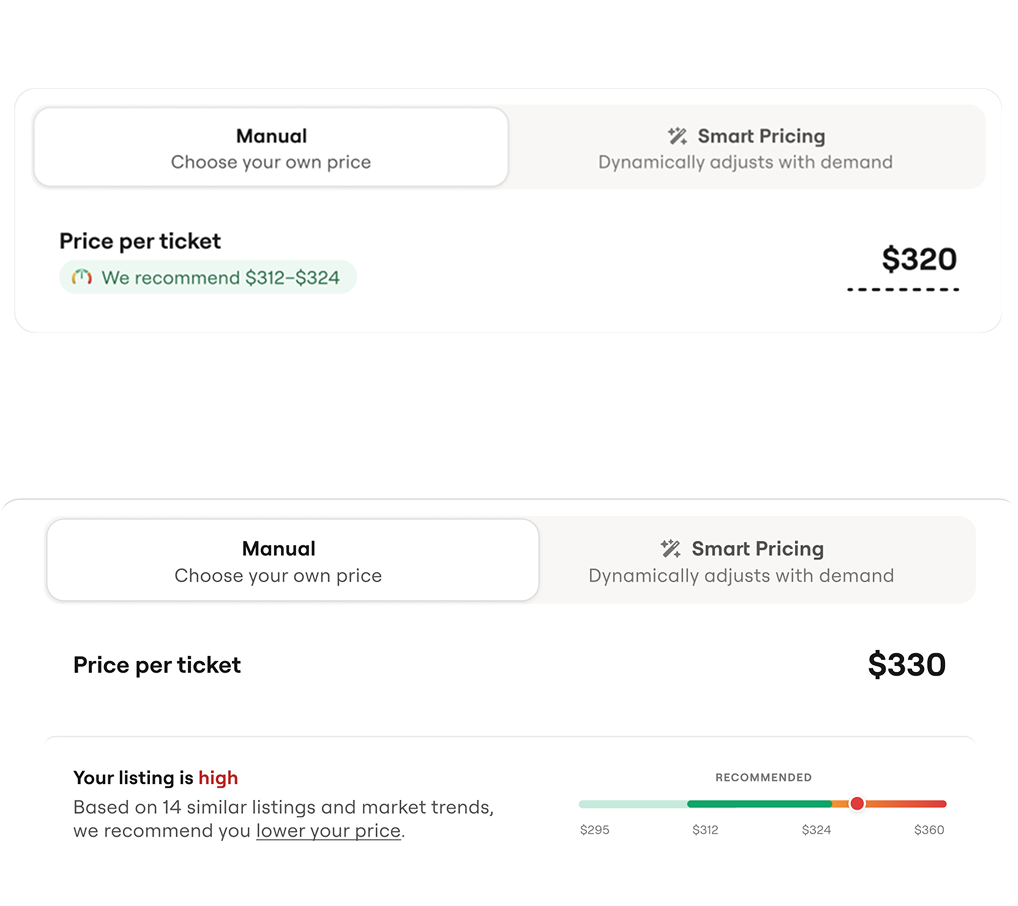
Rather than overwhelming sellers with more information, the final direction focused on making the recommendation itself more actionable.
Decisions I called:
- Make the recommendation the biggest takeaway
- Keep data accessible and reasoning simple to understand
- Make sure the visualization bar grounds the user in our recommendation but still gives them agency to make a decision
I defined the experience across pricing states, thresholds, missing data, and fallbacks so the experiment could actually ship. It’s currently live and collecting data!
Want to learn more? Contact me. This work is under NDA.